A donation of SEK 40 million from the Stena Foundation enables Chalmers University of Technology, Sweden, to recruit at the very highest international level to the first William Chalmers Professorship. The professorship focuses on health engineering and will concentrate on research at the interface between medicine and technology, in collaboration with Sahlgrenska University Hospital and the cluster of pharmaceutical and medical technology companies in Gothenburg.
To attract researchers in competition with the world’s leading universities, external funding in the form of donations from foundations and industry is crucial. The William Chalmers Professorship in health engineering is made possible through the Stena Foundation, which becomes the largest external contributor and whose donation complements Chalmers’ own investment of SEK 50 million.

“This demonstrates a strong vote of confidence in Chalmers. We are very pleased that the Stena Foundation shares our view of the importance that outstanding technical universities can have for the future. The generous donation allows us to establish a professorship with conditions that enable us to compete for the very best researchers in the world. It is an important step for Chalmers on its path toward becoming a technical university of international top class,” says Martin Nilsson Jacobi, President of Chalmers University of Technology.

“Through the support of the Stena Foundation, we want to strengthen Gothenburg’s leading position in health engineering. The professorship at Chalmers creates conditions for research that renews technology and medicine and delivers tangible societal benefits. It is an important step toward translating cutting-edge expertise into real impact for patients and society,” says Madeleine Olsson Eriksson, Chair of the Stena Foundation.
The professor who can now be recruited will build a research area within one of three designated fields – stem cell organoids, organ-on-a-chip, or bioelectronic interfaces* – and will pave the way for new advances where technology meets healthcare and medicine.
The professorship is a strategic investment in interdisciplinary research with high potential for innovation and societal impact. It plays a key role in the newly established Chalmers–Sahlgrenska Health Engineering Alliance, whose aim is to strengthen collaboration between Chalmers University of Technology, the Sahlgrenska Academy, the Faculty of Science and Technology at the University of Gothenburg, and Sahlgrenska University Hospital, while also enabling even closer collaboration with industry.

“Technology is becoming an increasingly important component of advanced healthcare and drug development, which means that the technical expertise at Chalmers is truly needed. This spans everything from data management to drug testing and precision medicine. Health engineering is an area in which Gothenburg could become a world leader, thanks to academia, the university hospital, and the strong pharmaceutical and medical technology industry cluster located here. We can lead a truly positive technological transformation,” says Mats Lundqvist, Vice President for Utilisation, Innovation and Lifelong Learning.
About the William Chalmers Professorships
As part of Chalmers’ ambition to become a technical university of international top rank, the university is introducing a new excellence position in research in the form of a professorship titled William Chalmers Distinguished Professor. This position is not a promotion step but an appointment made exclusively by invitation from Chalmers’ president.
* Stem cell organoids are cell cultures created from stem cells whose properties resemble those of tissues. Today, they are used, for example, in drug testing within precision medicine and in research investigating tissue regeneration.
Organ-on-a-chip refers to chips, or integrated circuits, containing a miniature environment that mimics the functions of an organ. The chip includes microscopic channels through which fluids such as nutrient solutions can flow, living cells from a specific organ, and membranes that can move to replicate functions such as breathing or blood pressure. They are used to simulate and study disease states and to test pharmaceuticals. In some cases, cells from a specific patient are used to determine which treatments work best for that individual.
Bioelectronic interfaces are technological systems that enable communication between living biological tissue and electronic devices.
Photo credits
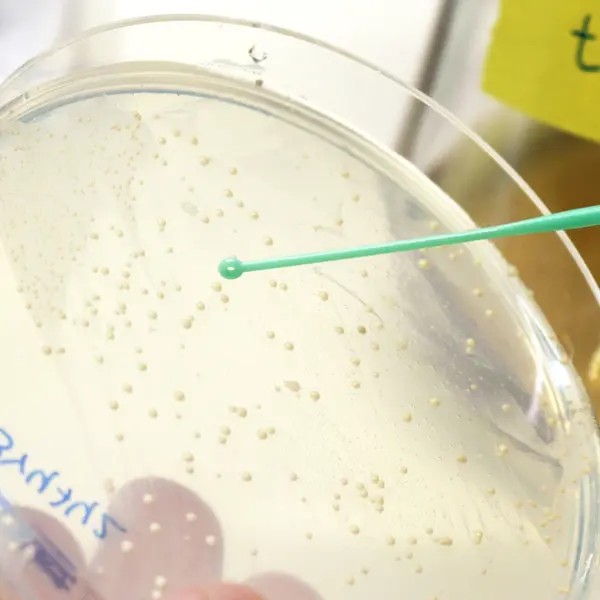
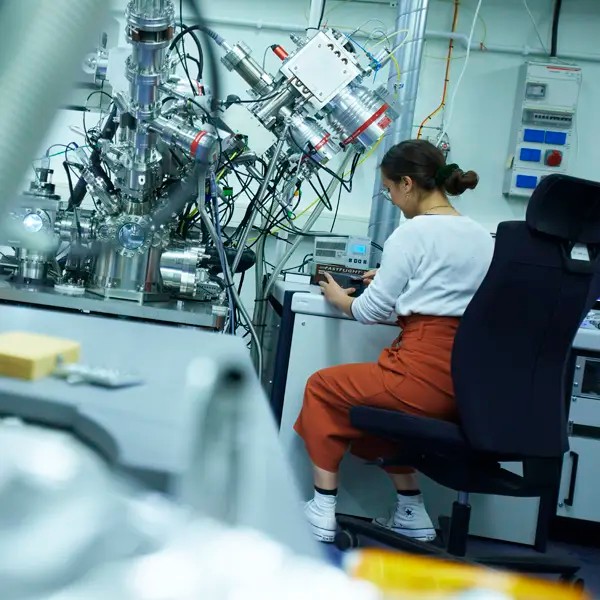
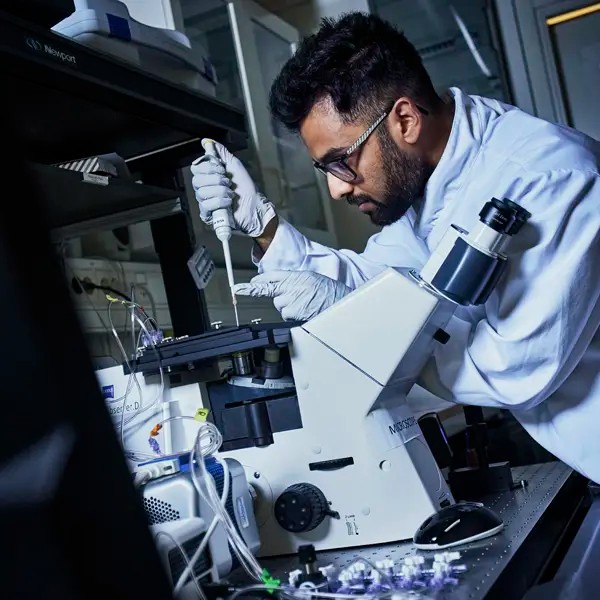
Photo collage: Images by Adi Goldstein / Brano / Louise Reed via Unsplash.com
Photo Martin Nilsson Jacobi: Chalmers / Anna-Lena Lundqvist
Photo Madeleine Olsson Eriksson: Sten A. Olsson Foundation for Research and Culture / Magnus Gotander
Photo Mats Lundqvist: Chalmers / Anna-Lena Lundqvist