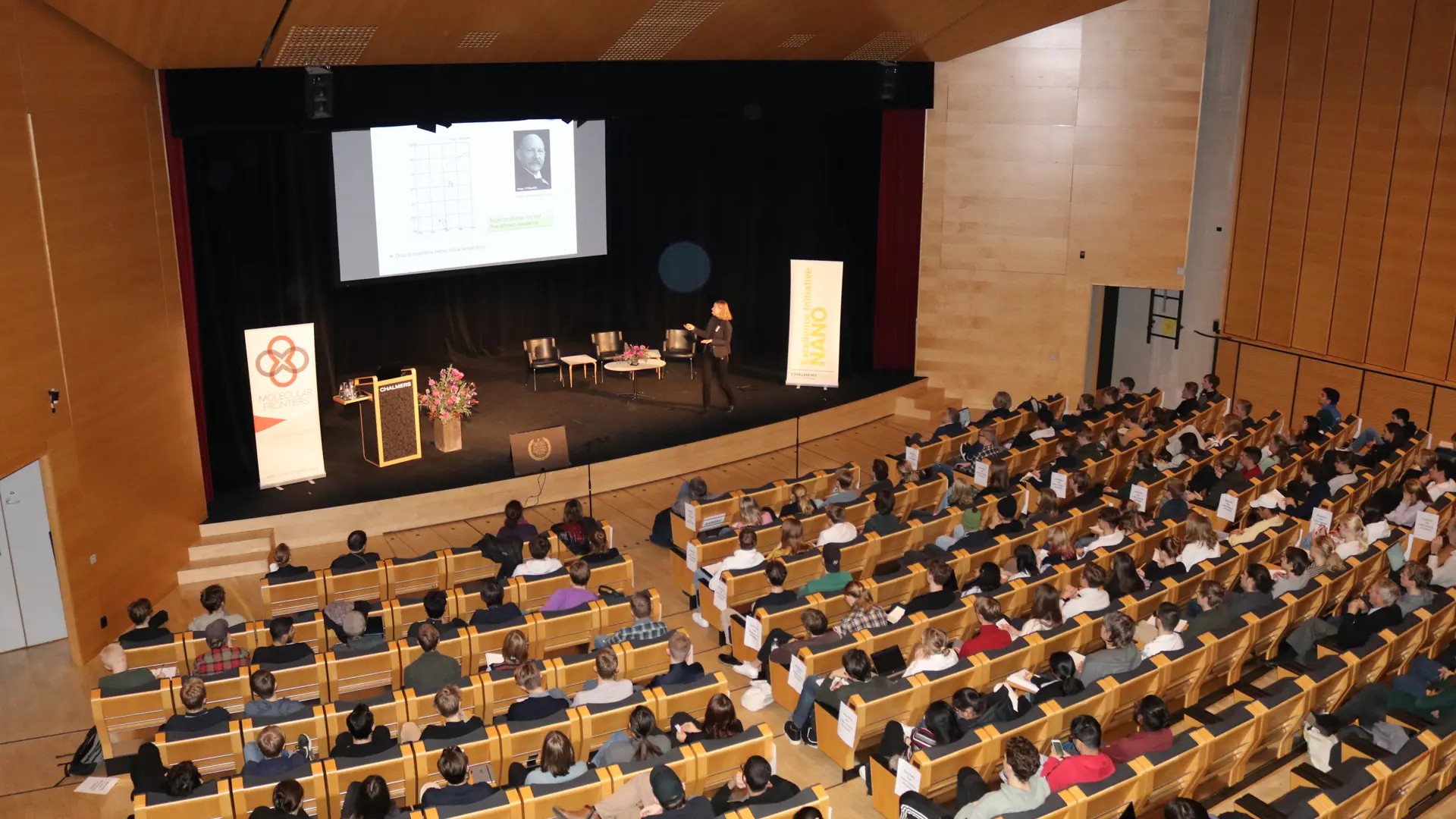
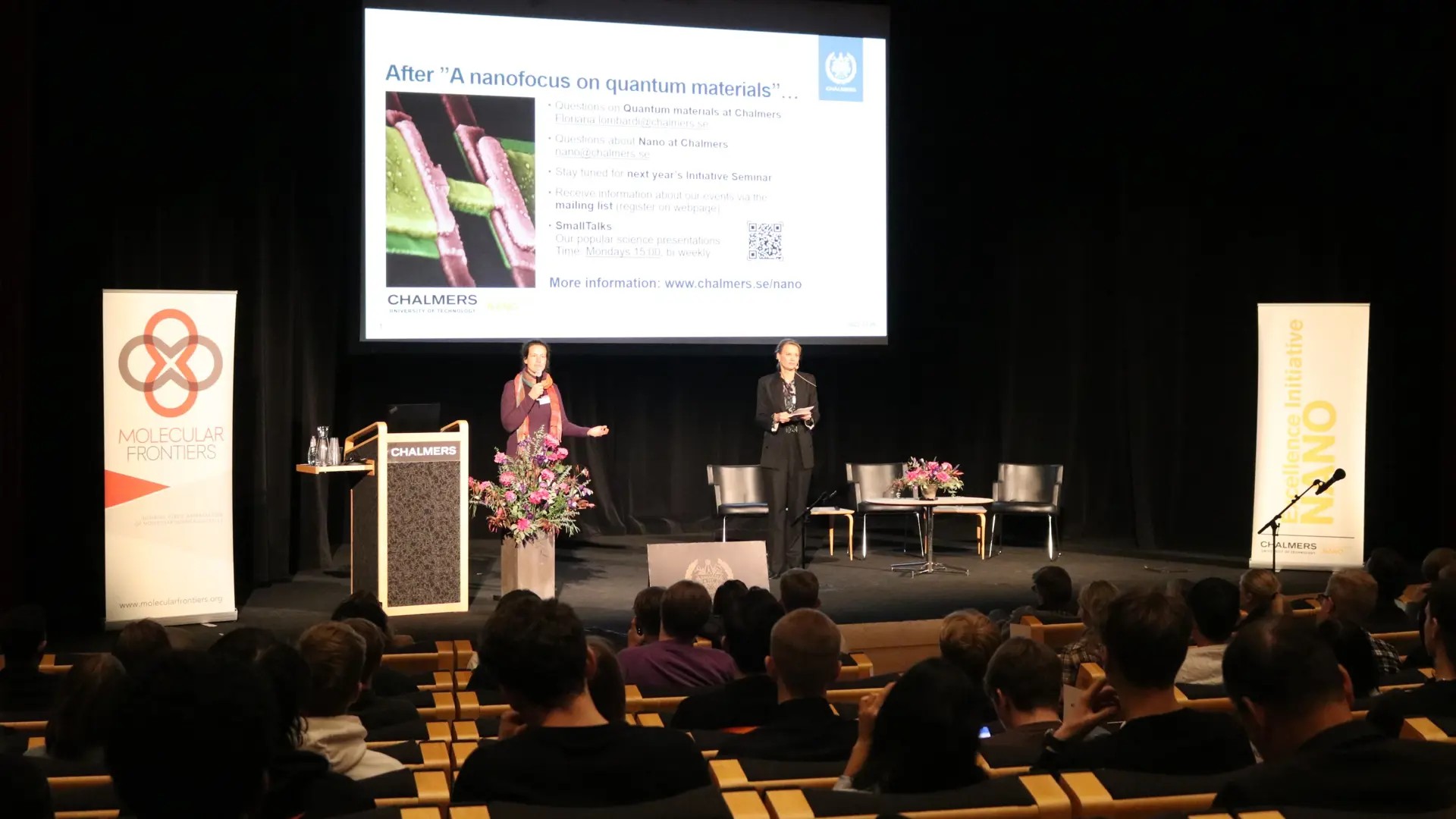
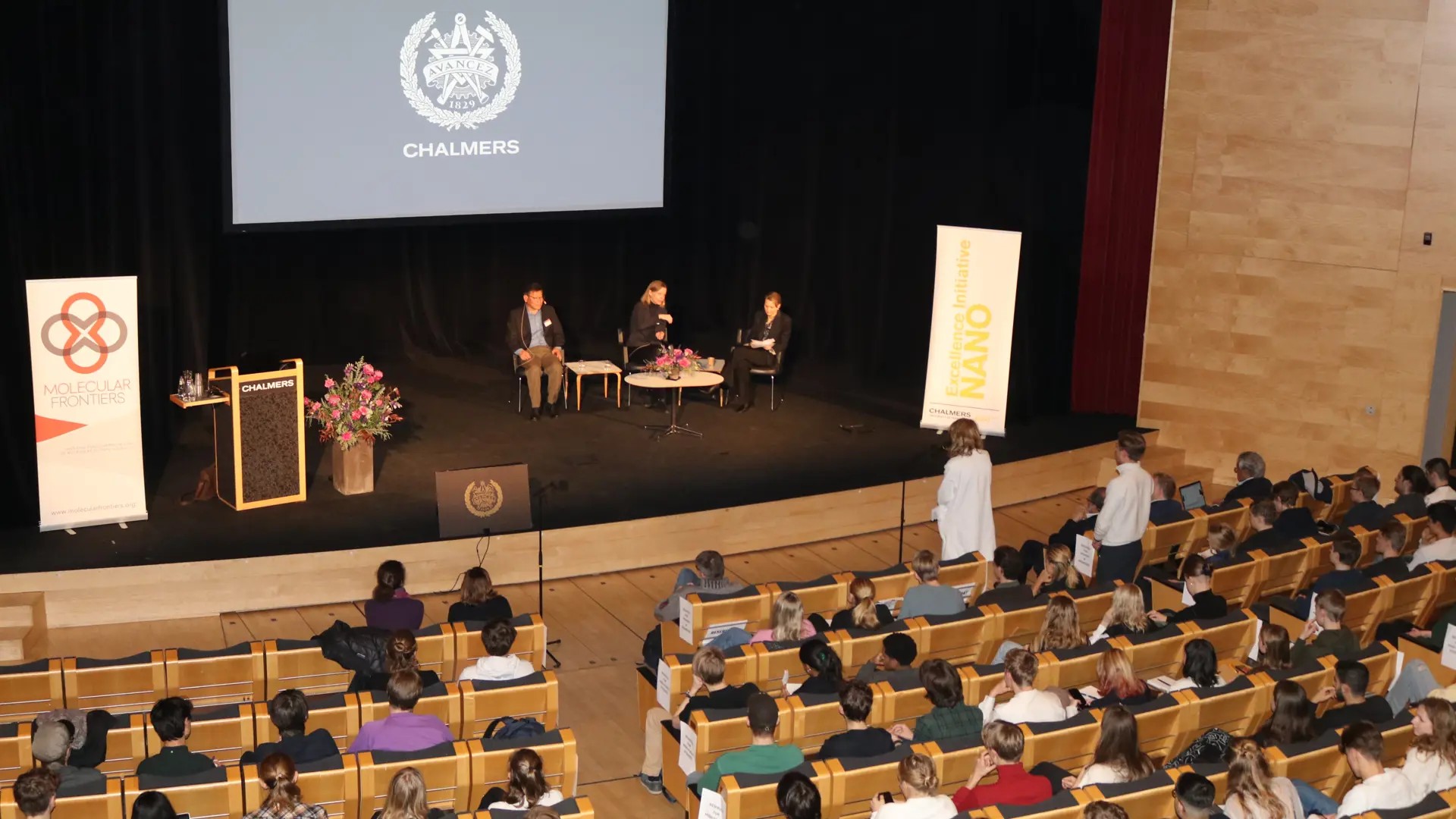
Two full days packed with lectures where high school students had the chance to ask all the questions they had ever wondered about nanomaterials to successful and well-known researchers from all over the world. That was one of the purposes with Chalmers' Excellence Initiative Nano's seminar "A nano focus on quantum materials"."We show what we do at Chalmers, but we also build connections and create enthusiasm among high school students", says Janine Splettstösser, leader of the Excellence Initiative Nano.
The initiative seminar was organized jointly between Chalmers' Area of Advance Nano (until the turn of the year called Excellence Initiative Nano) and Molecular Frontiers, took place November 28-29 in the Chalmers Student Union building, and was led by moderator Emma Frans. For two days, the participants had, among other things, lectures on the latest research in quantum materials.
“Quantum materials is a new area within Nano, and there is very active research going on there,” says Janine Splettstösser, professor in physics and leader of Area of Advance Nano.
“With a seminar like this, we create synergies, both within Chalmers and internationally. The speakers we had were really the absolute best that can be found in this field, they can come to Chalmers and see what we do, and we can share experiences and connect with them.”
The main organizers of the initiative seminar were Floriana Lombardi and Thilo Bauch, Professor and Associate Professor respectively at the MC2 department at Chalmers. Janine Splettstösser highlights the level of the invited speakers, and how they succeeded in creating a good mix of enthusiasm in the audience and at the same time talking about their current research.
"Even all of us who are not super-specialists could learn on a more general level - for me, for example, who does not work with quantum materials, I learned a lot about the field, and I felt that was case for many of us.”
In addition to the nearly 180 researchers who were on site, 135 high school students also participated - all with a burning interest in the area. Janine Splettstösser is lyrical about how the encounter between the researchers and the students turned out, and about how well-read and curious the students were. In several cases, she was surprised by their subject knowledge.
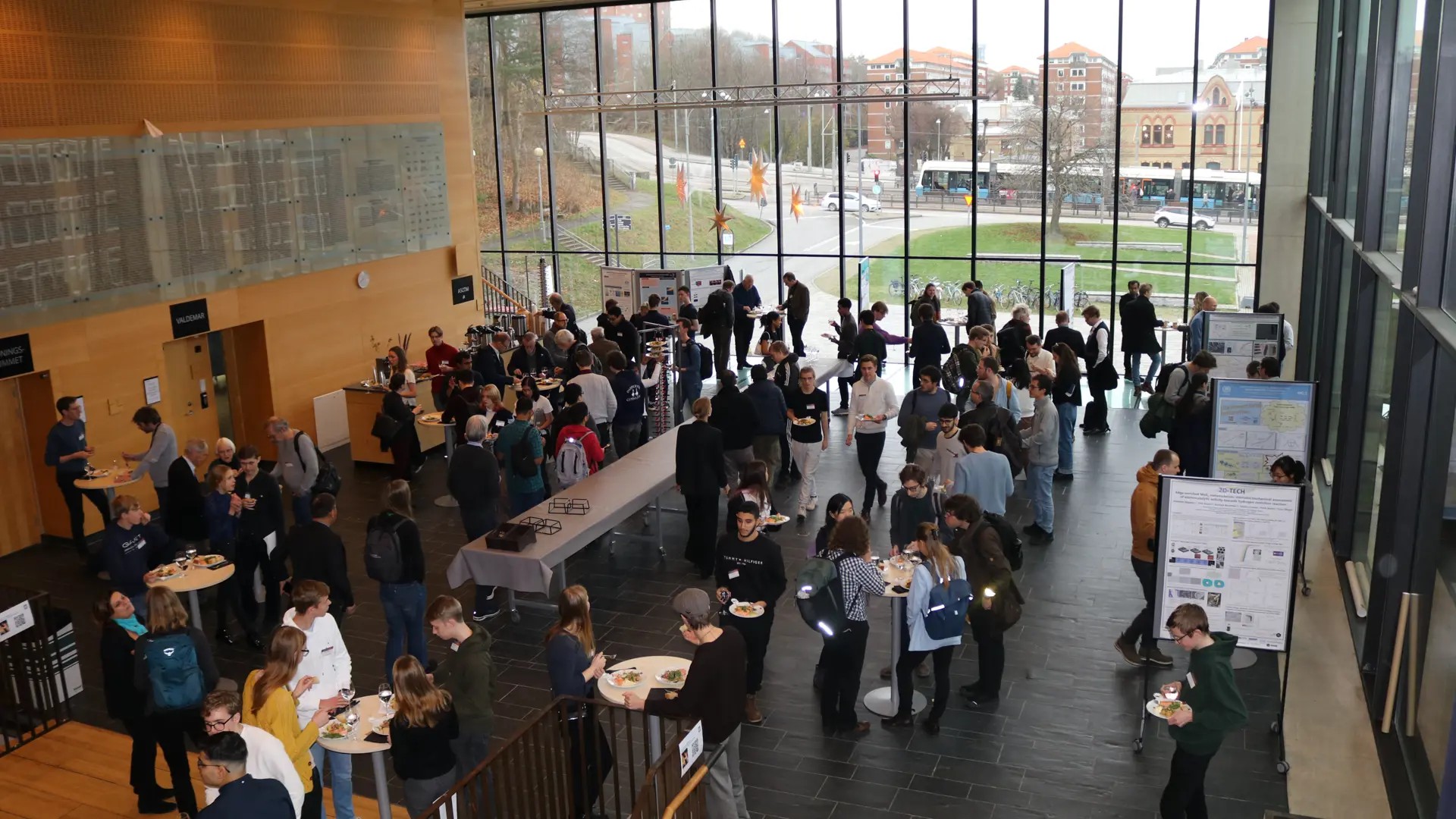
"Some of them asked questions that made me wonder how they know so much. Many of the students used the opportunity to talk much more with the speakers during the breaks, and some student contacted the speakers via LinkedIn after the initiative seminar. Some speakers told me that they couldn't even relax during the breaks, they were constantly talking to the high school students,” she says and laughs.
Per Thorén has been working for Molecular Frontiers for many years and is the one who has been in contact with high schools around Sweden. All schools with a science education have received an invitation with an opportunity to nominate two students to come to the seminar. To support schools that are located far from Gothenburg, there were also a possibility of receiving a travel grant that Area of Advance Nano finances, and students from a number of different cities came to the seminar, from Strömsund in the north of Sweden to Malmö in the south.
“The students who came here were extremely interested and motivated,” says Per Thorén.
“Different subject areas of course vary in difficulty, and quantum physics may be a little more difficult than, for example, something related to biology. Therefore, I prepared them by telling them about the concept, but also with information about the speakers where they could get familiar in advance with the research.”
Per Thorén emphasizes the high level of the research that were presented, that it is not in any way school lessons held for the students.
“One must be aware that it is very advanced research that is being presented,” he says. “These are the sharpest minds in these fields of research, and they present their very latest research findings — that's what the students got to hear about.”
The high level of the presentations and the seminar was received very positively by the students. Per Thorén says that several students have contacted him afterwards with positive reviews, and even teachers who nominated students have written to him and told him that the students came back to their schools very happy and satisfied.
Janine Splettstösser hopes that this kind of event can continue in the future.
“We are all very motivated to have a new event next year with a similar set-up but a different theme,” she says.
She also thinks that it is possible to broaden the concept to go beyond basic research, and to also connect to other areas of Chalmers' strengths and make it a joint venture.
- Full Professor, Applied Quantum Physics, Microtechnology and Nanoscience