
Award-winning research, new collaborations and future technologies were on display when EVS38 — one of the world’s premier conferences on electric transport — brought together participants from around the world in Gothenburg this summer.

Two Chalmers researchers awarded
One recipient was Anders Nordelöf, a researcher at the Department of Technology Management and Economics at Chalmers and professor at the Swedish National Road and Transport Research Institute (VTI). Alongside Anita Bongards of BorgWarner, he received the Best Lecture Paper award. Their paper,▶ “Allocating the environmental burdens in co-production of rare earth elements for EV magnets”, addresses how environmental impacts are allocated when rare earth metals are co-produced — a pivotal issue in assessing the climate footprint of magnets used in electric vehicles.
”It’s rewarding to receive confirmation that my research is relevant to the broader development of electromobility, and that it is considered to be of high quality in an international comparison,” says Nordelöf.
The article demonstrates how life-cycle analyses can yield different results depending on how the environmental burden is allocated among multiple materials in magnet production — a factor that can significantly influence comparisons, for instance, when switching between magnet types.
“The paper outlines the challenge of joint production, when the same process outputs multiple products. We examined extraction of rare earth elements, where the environmental burden typically is distributed based on the materials’ economic value — which fluctuates with price and demand. That can shift the impact for the same product over time, potentially causing confusion if the methodology is not well understood,” he adds.
This is especially relevant when choosing between dysprosium or terbium for thermal stabilisation of magnets, and how that choice affects their climate impact. It also matters when considering using alternative rare earths, like cerium, instead of those employed currently.

V2G research recognized
The second award went to Elena Malakhatka, a researcher at the Department of Architecture and Civil Engineering. She presented a service map for the user journey in Vehicle-to-Grid (V2G) — a tool that enables electric vehicles not just to draw power from the grid, but also to feed energy back when needed. In doing so, the vehicle battery becomes an energy reservoir capable of helping balance the grid.
“By clarifying roles and responsibilities, the understanding of how different actors contribute to the whole is improved. That makes cooperation easier and accelerates the transition to smart and sustainable energy systems,” says Malakhatka.
Her study is part of a larger V2G project in collaboration with Polestar, Svenska Kraftnät, Göteborg Energi, Vattenfall, Easee and Chalmers, financed by Vinnova.

International outlook and strong presence
Several researchers and centre directors emphasised the importance of EVS38 in bringing the entire sector — from academia to industry — together.
“For us it was crucial to gather all Swedish players within electromobility. The energy we felt was especially meaningful now in tough times. The opportunity to network with international actors gave extra momentum, and it was especially gratifying that heavy industry was represented as well. Despite global challenges, it is vital to convene and discuss electrification and the transition to a fossil-free vehicle fleet,” says Linda Olofsson, director of the Swedish Electromobility Centre.
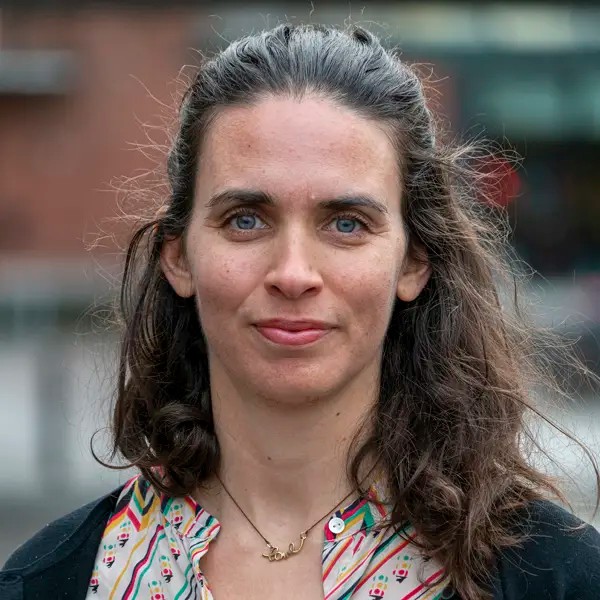
Frances Sprei, professor at the Division of Physical Resource Theory and an expert in sustainable mobility, participated both as moderator and speaker.
“There were many important discussions with researchers, policymakers and industry representatives. The breadth of participation and the ability to engage with so many actors make EVS especially valuable. One concrete example is our work on an EU application concerning the electrification of heavy transport, where we were able to meet across sectors and agree on a shared forward strategy. It demonstrates the significance of this arena,” she says.
She also took part in a session connected to the EU project MACBETH, where researchers across Europe collaborate to accelerate electrification in freight transport — focusing on megawatt charging, real-world data and cross-border infrastructure.
▶ MACBETH – Multipoint megAwatt Charging for Battery Electric Truck Hubs

Technologies pointing forward
Maria Grahn, associate professor at the Department of Mechanics and Maritime Sciences, participated alongside researchers from the competence centre TechForH2 — which develops hydrogen technologies for heavy transport.
“We presented a selection from TechForH2’s work — a Chalmers-led centre developing new hydrogen technology for heavy vehicles, including trucks, ships and aircraft. Everything from hydrogen-powered aviation to optical sensors was represented, and we had many productive discussions about future collaborations,” she says.
She emphasises the necessity of cooperation across industry, academia and public authorities to progress the transition to fossil-free energy and transport systems — and the role hydrogen may play in that shift. “No single actor can solve this alone, but together we can go further,” she states.

Anders Grauers, associate professor at the Department of Electrical Engineering, reflects on the pace of progress.
“Electric heavy trucks have moved extremely fast from research to established commercial products. Development is happening so rapidly that it's difficult to keep pace with all advances — but that’s not a bad problem to have, since many actors are driving progress from diverse angles. Now that the transition is underway, Chalmers’ role will partially shift — from proposing solutions for fossil-free transport to providing more specialised research to support companies and users within an established system,” he says.

Patxi Rodriguez Acero, a research engineer at the Department of Mechanics and Maritime Sciences, presented the ▶ AMES project – which studies how airborne unmanned vehicles can be integrated into future urban traffic environments.
“What sticks with me is the strong interest in the AMES R&D project, which explores how airborne unmanned vehicles can be integrated in future complex traffic settings. We received relevant questions on the technology, future applications and social acceptance. It was positive, offered valuable feedback, and affirmed that our work has broad relevance,” he says.
“By showcasing interior and exterior design for an urban air mobility ambulance, we gave visitors a clear image of future airborne healthcare. Even more important was highlighting the research still needed — and mapping the path forward. The combination of vision and real challenges helped position Chalmers as both forward-looking and grounded,” he adds.

Student projects inspiring confidence
Two of Chalmers’ best-known student projects ▶ Chalmers Solar Team and ▶ Chalmers Formula Student, participated in the exhibition, showcasing vehicles that blend innovation, sustainability and engineering.
For Chalmers Formula Student, EVS38 was a valuable chance to present their car and increase visibility with current and potential sponsors. The team highlights the many discussions with companies as a particularly inspiring component of the event.
Similarly, Chalmers Solar Team gained significant experience from EVS38.
Rickard Lennernäs, team manager for the 2025 squad, remarks:
“What we achieved best at EVS38 was setting the bar for ourselves. We want to be part of more exhibitions — something easily deprioritised when juggling car building, studies and everything else. But with support from Chalmers and motivated team members, we assembled a plan and a stand we were happy with. Being visible outwardly does so much for the long-term work of growing the team and building an even better solar car moving forward.”
“It’s an ongoing effort, so hopefully we’ll see ourselves again — by then with an even more exciting stand and the car that actually crossed the finish line in the 2025 Bridgestone World Solar Challenge.”
▶ Here in the calendar, you can see a part of Chalmers' program for EVS38.


