Astronomers have found water vapor around a young star at just the right distance - where new planets may be forming. The discovery, around the star HL Tau, is the best localisation yet of water in a stable and cool disc of dust and gas surrounding a young star. The discovery is a notable achievement for the telescope Alma and for technology developed at Chalmers.
The measurements reveal at least three times as much water as in all of Earth’s oceans. The water is located in the inner parts of the disc of gas and dust that surrounds the young Sun-like star HL Tauri, located 450 light-years away from Earth in the constellation Taurus.
The astronomers were able to discover the water content of different parts of the disc, using the 66 antennas of the telescope Alma (Atacama Large Millimeter/submillimeter Array), located at 5000 m above sea level in Chile. The findings are published today in a paper in the scientific journal Nature Astronomy.
“To date, ALMA is the only facility able to spatially resolve water in a cool planet-forming disc,” says Wouter Vlemmings, professor of radio astronomy at Chalmers and co-author of the paper.
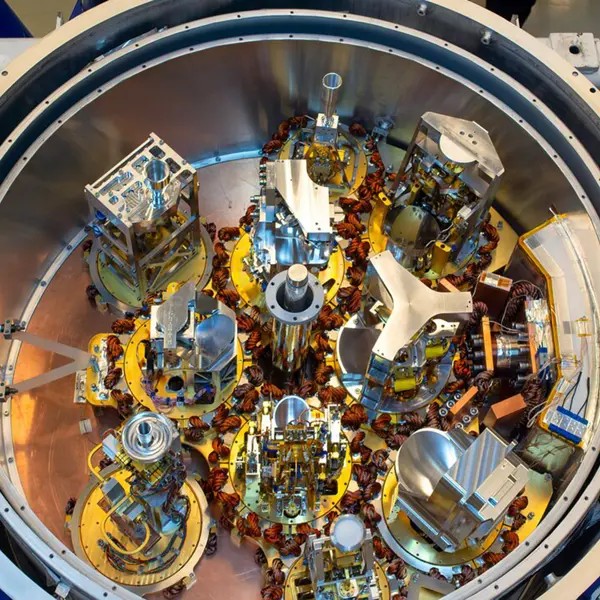
“It is especially exciting to fulfil one of the main goals of the Alma Band 5 receiver, which was developed by Onsala Space Observatory's Group for Advanced Receiver Development (GARD) at Chalmers", he adds.
The new observations used the Band 5 and Band 7 receivers on ALMA. Band 5 was developed by Chalmers and NOVA with involvement of ESO. With these receivers ALMA was able to observe in a new frequency range specifically for detecting and imaging water in the local Universe.
In this study, the team observed three spectral lines of water across the two receiver frequency ranges to map gas at different temperatures within the disc.
“It is truly exciting to directly witness, in a picture, water molecules being released from icy dust particles,” says Elizabeth Humphreys, astronomer at ESO who also participated in the study.
The dust grains that make up a disc are the seeds of planet formation, colliding and clumping into ever larger bodies orbiting the star. Astronomers believe that where it is cold enough for water to freeze onto dust particles, things stick together more efficiently — an ideal spot for planet formation.
“Our results show how the presence of water may influence the development of a planetary system, just like it did some 4.5 billion years ago in our own Solar System,” says Stefano Facchini, who led the research team.
More about the research
The research is presented in the paper “Resolved ALMA observations of water in the inner astronomical units of the HL Tau disk” by Stefano Facchini et al (https://doi.org/10.1038/s41550-024-02207w) in the journal Nature Astronomy.
Contacts
Robert Cumming, astronomer and communicator, Onsala Space Observatory, Chalmers, 070 4933114, robert.cumming@chalmers.se
Wouter Vlemmings, professor in radio astronomy, Chalmers, 031 772 63 54, wouter.vlemmings@chalmers.se