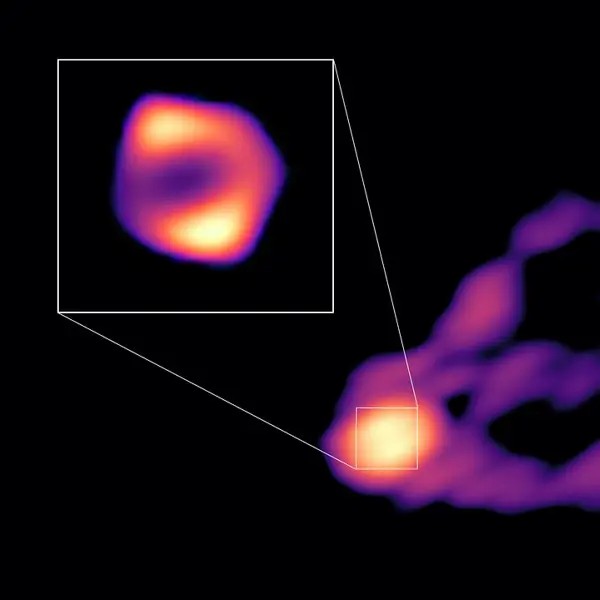
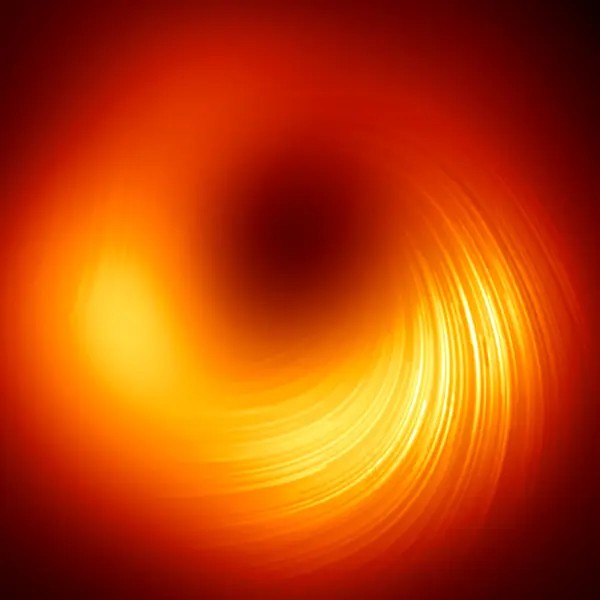
Chalmers University of Technology, Sweden, has received 13 million SEK from the Hasselblad Foundation to build a new camera for Sweden’s premier radio telescope. The new three-band camera is part of a global initiative to enable high-quality, multi-colour images of black holes and other space phenomena, using innovative technology that has excited astronomers since its first test runs in South Korea.
The world’s biggest and most iconic radio telescopes are joining forces with a bold aim – to make new images of black holes and their surroundings, in detail and in new colours. In Sweden, Chalmers University of Technology has just received a 13 million SEK grant to build a new, three-band camera for the country’s flagship radio telescope, the 20-metre telescope at Onsala Space Observatory. Private grants and donations are of essential importance to Chalmers’ long-term strategy to reach academic quality at the highest European level.
“This grant opens up exciting possibilities. Our new three-band camera will be a very different instrument than the Hasselblad cameras that took pictures on the Moon, but for us the goal is the same. We want to develop world-leading technology to image and understand phenomena in space”, says John Conway, director of the Onsala Space Observatory, and professor of radio astronomy at Chalmers.
Radio telescopes study the universe by detecting invisible light known as radio waves. By connecting antennas together in large networks, radio astronomers can make sharper images than it's possible to achieve with other kinds of telescope.
New cameras are now being built or planned at many of the world’s leading radio telescopes, and new possibilities are opening up, according to John Conway.
“Each of the new three-band cameras aims to be the best in the world. But they are all based on a new innovative technology that corrects for the way the Earth’s atmosphere distorts radio signals from far out in space”, says John Conway.
The new method is known as frequency phase transfer, or FPT, and was first proposed by astronomers Maria Rioja and Richard Dodson in Australia, following earlier work in Japan and Germany. Radio signals measured at high frequencies can be corrected for disturbances in Earth’s atmosphere, they suggested, as long as signals from the same source are also measured at lower frequencies at the same time – just what a three-band camera provides. The method has since been developed and implemented with great success by scientists and engineers at the Korean VLBI Network in South Korea.
“Thanks to this pioneering work, we now know that high-quality observations are possible even from sites with less than optimal weather conditions - something that once seemed out of reach. Now, with cameras specially built for this purpose, our telescopes will work together to help us explore black holes, the early universe, the lives of stars, and fast-changing cosmic events in greater detail than before," says Anton Zensus, director at the Max Planck Institute for Radio Astronomy in Bonn, Germany.
Sara Wallin, CEO of the Chalmers University of Technology Foundation, sees private research grants as an important part of the funding needed for competitive universities that deliver top-quality research.
“This grant from the Hasselblad Foundation will contribute to real progress in astronomy research. The joint effort between the Hasselblad foundation, Chalmers and Onsala Space Observatory is a clear example of how targeted investments in top-tier research and innovative technology development can make a big difference”, she says.
“We are proud of our long-standing collaboration with Onsala Space Observatory. The foundation was laid when Victor and Erna Hasselblad donated land to the observatory. Just as the Hasselblad camera once made it possible to see the Moon in a new way, the three-band camera contributes to exploring the universe with new precision. We look forward to following the results that this technology will enable”, says Kalle Sanner, CEO of the Hasselblad Foundation in Sweden.
Contacts
Robert Cumming, astronomer and communicator, Onsala Space Observatory, Chalmers University of Technology, Sweden, robert.cumming@chalmers.se, +46704933114, +46317725500
John Conway, director, Onsala Space Observatory, Chalmers University of Technology, Sweden, john.conway@chalmers.se
More about the observatory
Onsala Space Observatory is run by Chalmers with the support from the Swedish Research Council (Vetenskapsrådet) and the Swedish Mapping Authority (Lantmäteriet). Recently, international and national experts gave top marks to Onsala Space Observatory and its plans as part of a review of Swedish research infrastructures carried out by the research council. The experts highlighted the observatory’s high-profile science impact, high scientific return on investment and world-class technology development.
Photographer: MPIfR/Jongseo Kim et al (2025)
Photographer: Chalmers/Anna-Lena Lundqvist

Photographer: Chalmers/Anna-Lena Lundqvist

Photographer: Chalmers/Anna-Lena Lundqvist

Photographer: Chalmers/Anna-Lena Lundqvist

Photographer: Chalmers/Anna-Lena Lundqvist

Photographer: Chalmers/Anna-Lena Lundqvist

Photographer: Chalmers/Anna-Lena Lundqvist

- Full Professor, Onsala Space Observatory, Space, Earth and Environment

- Communications Officer, Onsala Space Observatory, Space, Earth and Environment