


For several years, Chalmers has built strong relations with the University of Rwanda. Now the next step is being taken in the collaboration through a five-year collaboration agreement, creating a base for Chalmers on the African continent. Vice President Mats Lundqvist and colleagues have visited the innovative university, and they see how entirely new opportunities are now opening up for researchers and students in both countries.
The University of Rwanda has played a major role in Rwanda’s reconstruction and is an important arena for innovation, research and education in the country. Mats Lundqvist, Vice President for Utilisation, Innovation and Lifelong Learning at Chalmers, is one of around ten colleagues who, at the end of 2025, visited the university – which impresses him in several ways.
"The University of Rwanda has new ways of thinking about innovation and entrepreneurship, and the country is truly at the forefront in health tech initiatives. We have a lot to learn from each other, and the strong collaboration we have already established has created great benefits for both parties", he says.
The collaboration between Chalmers and the University of Rwanda has been built up gradually since 2019, and has, among other things, led to research programmes, an innovation hub and incubator, joint research and development projects, and several student exchanges. Now the collaboration is being stepped up further thanks to a strategic, five-year collaboration agreement between the two universities, which was signed in 2025.

Chalmers gains a base in Africa
Helene Ahlborg, Associate Professor and social science energy researcher with a focus on the East African region, leads Chalmers’ initiative in Rwanda. She says that the agreement will create a clear platform for Chalmers in the country, and remove the barriers that may exist for research on the African continent.
"Africa is an incredibly important part of the world for global development. Chalmers has now co-created a hub on the African continent, which many Chalmers colleagues can work from. This offers great opportunities to build research collaborations and projects based on the ideas and demand that may exist at the two universities. At the same time, student exchanges and student innovation will be an important foundation of the partnership", she says.
In addition to research and education, utilisation and innovation have been central to the collaboration with the University of Rwanda throughout, and the partnership focuses above all on the three areas of energy, AI and health tech. When the delegation from Chalmers recently visited the university, participants were able to see the extensive ripple effects the collaboration has already led to.

Chalmers Fuse a role model for an African makerspace
Among other things, Chalmers has helped to create a model for so-called UnIPods (University Innovation Pod) in which students play a central role. A UnIPod is a design and makerspace, or innovation arena, funded by the United Nations Development Programme (UNDP). The idea is to give young innovators tools and support to transform ideas into prototypes and start-ups, and UnIPods are now being launched at more and more universities on the African continent.
Chalmers’ entrepreneurial ecosystem – and not least the university’s makerspace Fuse – has been a clear source of inspiration for the UnIPod Rwanda’s way of working and has led the UNDP to ask for its wider application.
"It feels significant", says Mats Lundqvist. "It warms my heart that what we have built at Chalmers has now had a direct impact on shaping a model for student leadership at UnIPod – a model that is now to be spread to over 40 countries in Africa."
“Smart-frugal” innovation meets Scandinavian ways of thinking
But Chalmers also has much to learn from how the context in Rwanda stimulates innovation, Mats Lundqvist points out. While the Scandinavian innovation system is largely built on financiers making regular investments in start-ups – which sometimes have very resource-intensive development phases – Rwanda has a completely different innovation culture, based on significantly tighter conditions. This is often called frugal innovation, or “smart-frugal” innovation as Mats Lundqvist prefers to describe it, and it is something that requires creativity, perseverance, and really being able to turn over every opportunity that exists.
"Frugal innovation requires you to pinpoint the most important needs and what truly matters, in order to create robust, flexible solutions that work under resource-scarce conditions. I think a frugal starting point is good in many ways. And the combination of this “smart-frugal” mindset and our Scandinavian focus in innovation – which is very much about creating value for others – is very exciting", says Mats Lundqvist.

Chalmers’ innovation culture inspires
During the extensive visit, the Chalmers delegation also met Karin Tegmark Wisell, Sweden’s Ambassador for Global Health. She was in Rwanda to discuss health innovation and how Sweden can engage in international collaborations in the field – something Chalmers has great opportunities to contribute to.
Maria Saline, Project Leader at the University Executive Office and one of the participants on the trip, perceives that Karin Tegmark Wisell was greatly impressed by how Chalmers works with innovation and entrepreneurship to make use of research results.
"I think we opened her eyes to the fact that innovation in health is so much broader than just hospital care itself. Supporting innovation in medical technology or digitalisation is also central to the health field, and can lead to innovations and new ideas that deliver very great patient benefit", says Maria Saline.
The goal: a permanent initiative
In 2026, a physical Chalmers office with several staff members will be inaugurated at the University of Rwanda, located at the UnIPod that Chalmers has helped to build up. This will be another step in the partnership between the two universities. The aim is to further strengthen the partnership’s contacts with collaborators in academia and industry, and pave the way for more research activities, utilisation initiatives, and education and exchange programmes for students.
"Our strong relationships have already been translated into collaborative research, entrepreneurial learning and fantastic opportunities for students. This is not just a temporary project. The goal is to make our presence in Rwanda permanent so that we can truly seize the opportunities this initiative provides", says Mats Lundqvist.

More about Chalmers’ partnership with the University of Rwanda
In 2025, a strategic, five-year collaboration agreement was signed between Chalmers and the University of Rwanda, building on the research collaborations and student exchanges that have been ongoing since 2019 between the two universities. The goal is to create an ecosystem in research, education and utilisation with a strong focus on innovation for societal benefit. The partnership mainly focuses on the areas of energy, AI and health tech.
Participants on the trip to the University of Rwanda:
- Mats Lundqvist, Professor, Entrepreneurship and Strategy, and Vice President for Utilisation, Innovation and Lifelong Learning
- Torbjörn Lundh, Professor, Applied Mathematics and Statistics, and Advisor to the President on internationalisation
- Helene Ahlborg, Associate Professor and Project Leader for Chalmers’ Rwanda collaboration
- Maria Saline, Project Leader at the University Executive Office with responsibility for health tech collaboration
- Mikael Persson, Professor Emeritus, Signal Processing and Biomedical Engineering
- Philippas Tsigas, Professor, Computer and Network Systems
- Peace Iraguha, Chalmers’ Academic Collaboration and Partnership Coordinator, based at the University of Rwanda
- Daniela Michael, Project Leader, University of Gothenburg

- Head of Unit, Environmental Systems Analysis, Environmental and Energy Sciences
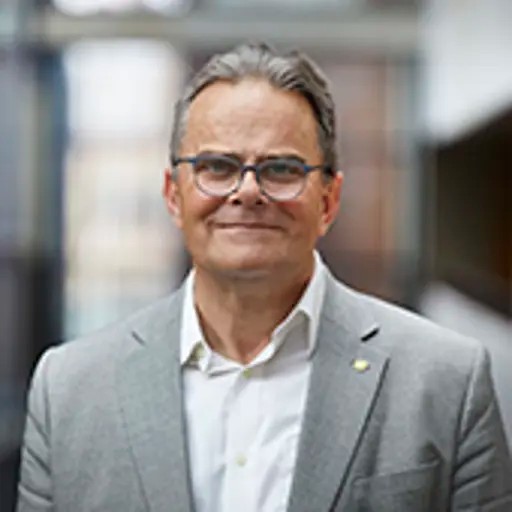
- Vice President, Utilization, innovation and lifelong learning

- Project Leader, University Executive Office, Chalmers Operations Support
