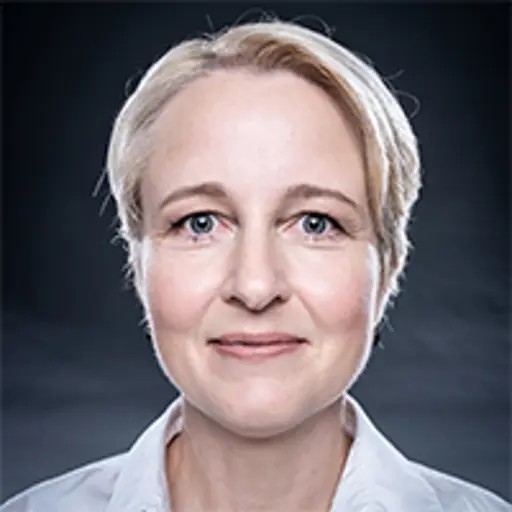
“I find the brain incredibly fascinating. The fascination many people feel for space is the same fascination I feel for the brain,” says Maria Asplund, Professor of Bioelectronic Microtechnology at Chalmers University of Technology and head of the Chalmers Area of Advance Health and Technology.
In the Vera podcast, journalist Malin Avenius meets her to talk about how electricity can be used to heal the body and restore lost bodily functions.
Maria Asplund’s research explores how electrical signals can interact with the nervous system. Her work includes artificial visual perceptions generated by electrical impulses, spinal implants that may restore movement in paralysed body parts, and wound dressings that guide skin cells to close hard-to-heal wounds.
“The nervous system is fundamentally an electrical system. Nerves communicate through electrical and chemical signals,” she explains.
Bioelectronics and neuroelectronics, she says, are essentially classical engineering adapted to function inside the human body. One major challenge is developing materials that are durable, flexible and well tolerated by human tissue.
Maria Asplund is Professor of Bioelectronic Microtechnology and head of the Chalmers Area of Advance Health and Technology.
About Verapodden
You can listen to the podcast in the following channels:
Project leaders: Cecilia Hillman & Maria Saline, Genie
Original music by Stefan Karlsson
Programme manager, technology & editing: Malin Avenius
Producer: Anne-Christine Nordin
Art Director: Carina Schultz
Vera Sandberg became Sweden's first female engineer in 1917. She studied as the only woman among 500 men. Today, Chalmers University of Technology has 10,500 students and one third are women.
Chalmers´Programme and Courses:
Chalmers University of Technology offers a comprehensive technological and scientific education, from bachelor’s level to master’s and doctoral degrees. Read nore: Programmes and courses
- Professor, Electronics Material and Systems, Microtechnology and Nanoscience