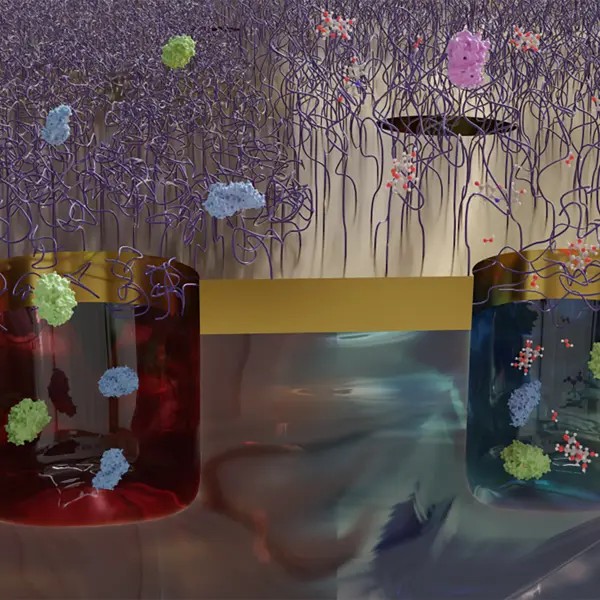
Recently featured in Nature for a breakthrough study on the world’s smallest pixels, Professor Andreas Dahlin, Applied Chemistry, Chalmers University of Technology, is one of the keynote speakers at this year’s Materials for Tomorrow. In this interview, he answers four quick questions about how nature inspires his research, why nuclear pore complexes are so fascinating, and how bioinspired materials could shape the technologies of the future.
Your research explores how nature inspires new ways to design and control materials. What fascinates you most about this field?
"I am generally fascinated by living matter and the amazing features it can achieve, which in many cases remain impossible with human technologies. After centuries of science, Mother Nature still tends to beat us."
What can engineers and materials scientists learn from nature’s way of solving complex challenges at the smallest scales?
"I think we need to see that soft matter with high complexity is key. Inorganic solid materials are great for things like electronics and computers, but dynamic structures and responsiveness are needed for more intelligent and “adaptive” materials."
If you could apply one principle from your research to real-world technologies, what would it be – and why?
"We are generally working on controlling the interface between living and artificial systems. In particular, we try to achieve selective capture of biomolecules for purification purposes. This is important for biotechnology but also to enable cheaper production of pharmaceuticals – in order to make them available in the developing world, which is a strong motivation for me."
What are you most looking forward to at the Materials for Tomorrow conference?
"I am very curious to see how my presentation is perceived, since this particular topic will be about very fundamental research for which there is currently no clear application. It will actually not be a material “for tomorrow”, but I hope to show it is still fascinating."
Related content
▶ Minimal pixels achieve the highest possible resolution visible to the human eye – a Nature study with researchers from Chalmers, Uppsala University and the University of Gothenburg.
▶ Materials for Tomorrow 2025 – Bioinspired Materials
▶ Register to the conference by 3 November
▶ 4 questions with Chiara Micheletti – exploring the secrets of bone and bioinspired design