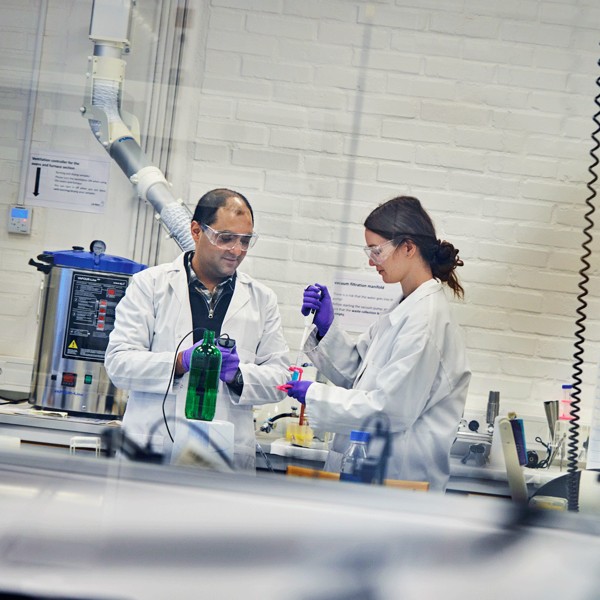
Shining a light on water quality to improve drinking water treatment
Overview
- Date:Starts 11 June 2024, 15:00Ends 11 June 2024, 16:00
- Language:English
Welcome to Kate Murphy's Promotion lecture as Professor at the Division of Water Environment Technology. Kate will present on the theme "Drinking water quality" and tell us more about how the presence of dissolved organic matter impacts the water treatment process, and possible measures to improve efficiency and sustainability of these processes.
This open lecture is about half an hour, followed by some time for questions. After the lecture we mingle and celebrate the promotion with a festive fika.
Abstract
The water in our drinking water reservoirs needs treating before it is safe for us to drink. Treatment usually involves subjecting the water to a sequence of barriers which successively remove microbes and chemicals along with unpleasant tastes and odours. Increasingly in connection with urbanisation and climate change, the quality of water in drinking water reservoirs is threatened by increasing loadings of harmful microbes and pollutants. Additionally in the northern hemisphere, water is becoming browner due to increasing natural carbon compounds called dissolved organic matter (DOM). All of these microbes and chemicals need to be removed during treatment, making drinking water treatment today more costly and difficult than in times gone by.
The most efficient way to treat water depends on its chemical composition, which at a given location can change slowly with the seasons or rapidly over hours or days, such as when a lake turns over, or algae starts to bloom, or when there is heavy rainfall. A challenge for water producers is obtaining up-to-date information on all aspects of water quality that can impact operational decisions and treatment outcomes at the plant. For example, it is difficult and costly to measure changes in DOM reactivity, although this parameter affects the performance of all treatment barriers and hence the overall cost of treatment. At this talk I will discuss how the real-time detection of DOM reactivity in water can open up new possibilities for improving the efficiency and sustainability of drinking water treatment.

- Professor, Water Environment Technology, Architecture and Civil Engineering